Tuesday, July 14, 2009

Cabbage Head


The cabbage head has a very humble reputation. With traditions born of poverty or plain lack of creativity, it's often greeted with sighs or wry expressions of disappointment. I say unfair! The very qualities that make cabbage a food of subsistence are those that should make it a superstar! It is loaded with vitamins (B2, B6, folate, C and K), minerals (phosphorous, potassium and manganese, oh my!), and that cancer-fighting class of chemicals that have been given the not-very-illuminating name of "phytonutrients" (or, nutrients in plants...duh.). It also has fiber, and, something more appreciated today, no fat (and it would laugh at the concept of trans fatty acids). It can last all winter if properly stored, which means you can get a hefty dose of what's good for you when there's not much growing in the snow.

For the sake of comparison and contrast, take a more popular food, one that gets cheers from children and adults alike, say, some kind of Cheez Doodles. Vitamins, minerals and phytonutrients? I don't think so. Absence of calorie-laden fats? Um, no. (I won't go down the "partially hydrogenated" road.) Sure they can last all winter if you don't open the bag, but good luck with that. Sure, they're crunchy, but does a cabbage not also have crunch? And cabbage would never stain your fingers day-glo orange, even if you ate it with your fingers.

Okay, so the contrast may be an insincere one, but the point is that cabbage should get a little more respect. Chances are that some form of cabbage kept your ancestors alive at some point in history.
Since I'm usually cooking for two (although I'd happily cook for you, too, if you want to come and visit), I can cut a nice big head of cabbage, like the one above from our CSA, in half and use it two different ways. On the first cabbage day, I finely chopped the cabbage, sauteed it in butter, and flavored it with cider vinegar and caraway seeds. It is a simple dish, but don't let that fool you. It is flavorful and satisfying. I love caraway, and think it's great with cabbage, and the vinegar allows a hint at the tart, fermented flavors of sauerkraut, but with instant gratification. (No, I don't make my own sauerkraut, but am fully aware that nothing compares to homemade.)

You can use a food processor to cut up the cabbage (I didn't happen to have space on the counter the day I made sauteed cabbage). I don't use the shredding blade, but prefer to cut the cabbage into small wedges and use the slicing blade. I find the shredder on my machine pulverizes cabbage more than I like, especially for this dish.


While this was cooking, Harry asked if it was wrong that the aromas wafting through the apartment made him think of comfort food. No, Dear Husband, you're far from wrong. Eat cabbage and be comforted.


Sauteed Cabbage with Caraway and Cider Vinegar

2 tablespoons butter
1/2 large head cabbage, chopped or shredded (about 6 cups)
1 teaspoon kosher salt
3 tablespoons cider vinegar
1 teaspoon caraway seeds

1. Melt the butter in a large frying pan over medium heat. Add the cabbage and salt and saute for 10 to 12 minutes until the cabbage is wilted and just begins to brown, stirring often.

2. Add the vinegar and caraway seeds. Reduce the heat to medium-low and cook, stirring often, about 15 minutes more or until the cabbage has softened, but still has a bit of crunch.

About 4 side dish servings


Sunday, July 12, 2009

Lazy Man Peas


I wouldn't eat the dull green, mushy, overcooked peas that seemed ubiquitous when I was a kid, but if I could pick some "real" peas off those stringy vines in the garden, I'd stay out there and eat them all day. I don't think peas grew so well in my mother's sandy garden, but they did in my grandparents' Eden of Northern Michigan.

I remember being in that garden with Grandpa Vic when he told me about a new kind of pea he had planted. He called them Lazy Man peas. "You don't even have to take them out of the pod. You just eat them pod and all." Of course I didn't tell him that I was pretty happy to eat the pods of regular peas once I had unzipped the package and plucked out the sweet jewels inside. Sure, they were stringy, but I could spit out the fibrous stuff when no one was looking. Just one crunch of the Lazy Man peas, however, and I knew there was a difference. The pod was plump, juicy and flavorful.

Those new Lazy Man peas must have been Sugar Snap peas, which were introduced by a breeder in the 1970s, shortly before my grandpa would have procured them for his vegetable garden (although fleshy-pod peas have been around for 300 years or more. I guess these Sugar Snaps were better, though.)

Now, the CSA to which we belong grows Sugar Snaps, and I can't get enough of them. The season seems to be coming to an end, but I adapted a recipe for pickled Sugar Snap peas I found on one of my favorite food blogs, Smitten Kitchen, so I can preserve them for a while longer. I've had them in a bowl in the refrigerator for a few days, and they taste pretty good already. The author of Smitten Kitchen suggests that they could be enjoyed within 24 hours of immersion.

I gave my version a little Asian flair by adding rice vinegar and a little fresh ginger. They're a nice combination of pickle-sour with a touch of sweet, and a little heat. I'm thinking they will be good as an accompaniment to the chickpea pancakes I've made from the book Madhur Jaffrey's World Vegetarian.

The peas we get from our CSA are quite tender and rarely have thick strings, but the stem end of the pea should be removed, and the strings on your peas may need to be as well. Once you snap off the stem end of the pod, you can usually sort of unzip the string from one side.


Lazy Man Pickles (Pickled Sugar Snap Peas)
Adapted from Smitten Kitchen

3/4 cup distilled white vinegar
1/2 cup rice vinegar
1 tablespoon kosher salt
1 tablespoon sugar
1 1/4 cups cold water
1 pound Sugar Snap peas
4 garlic cloves, sliced thin
1 inch piece of fresh ginger, peeled and sliced thin
1 large or 2 small dried chile peppers, broken in half

Note: "Nonreactive" equipment and containers need to be used in this recipe in order to keep the acidic vinegars from tarnishing surfaces or leaching undesirable chemicals.

1. In a nonreactive saucepan, heat the vinegars, salt and sugar until the sugar and salt have completely dissolved. Add the cold water, and set aside to cool.

2. Remove the stem ends and any strings from the Sugar Snap peas. Place the peas, garlic, ginger, and chile in a large bowl or jar. When the liquid mixture is cool, pour it over the pea mixture.

3. Cover and allow to pickle in the refrigerator at least 24 hours. Longer is better.

Tuesday, July 7, 2009

Grill, Baby, Grill


'Tis the season to be grilling! It's back to "normal" post-solstice temperatures (we had a rather cool spell...you'll never hear me complain about that) and at such times I try to avoid using the kitchen in the late afternoon, except to make salads and scoop ice cream. The grill wheels itself out to our rescue in an admirably faithful manner. (Okay, so I have to wheel it out myself, but it's still faithful, despite being stored for a few winters on the porch without a cover, partially exposed to the bitter Minnesota elements.)

I love grilled food. Anything I can cook over even our relatively flavorless (compared to charcoal) propane flame somehow always tastes better. I love to grill vegetables and potatoes and even bread (and the occasional marshmallow destined to be squashed between graham crackers with a chocolate bar), but it seems that meat tends to take center stage, or center grate, on our grill. And I love barbecue sauce. Our grill may be the greatest saboteur in my hopes of someday being at least mostly vegetarian.

I have dreams of someday perfecting my own barbecue sauce (Anne Marie's Super-Atomic Gusto Sauce: guaranteed to stain your apron and blow your mind!) I haven't even begun my food detective work on that case yet, but I do have an Asian-inspired marinade/sauce that is quite reliable. It is flavored with hoisin sauce, a Chinese barbecue-style sauce that I'm not crazy about in dishes like stir fry or fried rice. But put it on a barbecue, and I'll lick it off my fingers.

This marinade is easy to throw together and will keep for a while in the refrigerator (just don't keep any sauce in which you already marinated something.) It makes enough to marinade and glaze about six servings of your choice of protein. (I usually make half of this recipe, since I most often cook for two.)

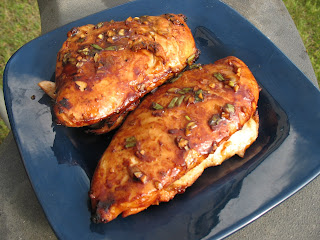
I have picked, chosen, and consolidated several recipes for hoisin-based marinades and sauces and have settled (for now) on one that is almost as versatile as it is delicious. I've used it on chicken, steak, pork loin, salmon and tofu, and have loved the results with each one. I bet you could brush it on shrimp or scallops as well. I just marinate whatever I'm cooking in some of the sauce, putting the remainder aside to brush on later. I marinate beef, chicken and pork for several hours; salmon for 30 minutes; and tofu for as long as is convenient. When the marinating is complete, I discard the marinade and put the food on a hot grill.


I then glaze it with the reserved sauce as it cooks. It forms a nice glaze and has tremendous flavor that hints at American-style barbecue sauce, but with a performing cast that is clearly Asian, with soy sauce and sesame oil politely requesting notice.

You should be able to find hoisin sauce in the supermarket with other Asian ingredients in the ethnic foods aisle. Shao Hsing wine (you may find it spelled differently, like shaoxing) is harder to find, but is increasingly available in ethnic aisles at supermarkets as well. I think I found my bottle at Woodman's. If you can't find it, you could substitute dry sherry, or broth, which is probably more convenient.

Chinese-Style Barbecue Sauce and Marinade

1/2 cup hoisin sauce
1/4 cup finely-chopped green onions (scallions)
1/4 cup soy sauce
2 tablespoons rice vinegar
4 garlic cloves, minced
2 tablespoons peeled ginger, minced
2 tablespoons sesame oil
2 tablespoons Shao Hsing wind, dry sherry, or broth
1/2 teaspoon crushed red pepper flakes

1. Combine all ingredients and mix well. Use as marinade or barbecue sauce.

Makes enough for at least 6 servings of grillable protein.

Wednesday, July 1, 2009

Twenty-Five and Counting


I’m celebrating. This is my 25th post to The Messy Apron (Hooray!...for she’s a jolly good blogger…). I have to admit that my life has changed at least a little since I started blogging about what I’m cooking, developing and sharing recipes, and taking digital photos of what I’m about to devour. For one thing, I say things like, “Where’s the camera? I’m going to start dinner,” significantly more often.

I also am documenting recipes and other kitchen adventures better than I did before, which was a major goal of this whole endeavor. I still have a long way to go before I can give my recipe collection the illustrious title of “Organized,” but it’s just been too much fun writing these little notes to you over the last few months. (I even understand that a few of these posts have been printed and mailed to my grandmother, who doesn’t own a computer.)

So what does a food blogger do to celebrate the 25-post milestone? Why, bake a cake of course.

I had plenty of leftover rhubarb from the CSA*, homemade yogurt, and a recipe from Cooking Light Magazine that was close enough. This cake is nicely tart from the rhubarb and manages to be very moist without being mushy. We ate it when it was too hot (delicious), just right (delicious), and a few days old (still delicious!) It stays moist without getting watery or gloppy as a few days go by. Even though there were only two of us eating it, it didn’t last more than a couple days. I’ll admit it here and now: we even ate it for breakfast.

I’ve started adding whole wheat pastry flour to more of my baking recipes to help improve their WFQ**. It is becoming increasingly easy to find, even in supermarkets. Usually I purchase it in bulk from the local co-op, so I can buy just what I need short-term, but last week I bought a whole bag of Bob’s Red Mill brand at a supermarket (Woodman’s, to be exact. They have almost everything!) Now I have to use up 5 pounds of whole wheat pastry flour! It looks like there will be a lot more to post to The Messy Apron for a long time to come!

Rhubarb Yogurt Cake
Adapted from Cooking Light magazine
3 cups of chopped rhubarb is a little less than a pound.

Topping
½ cup light brown sugar
½ teaspoon cinnamon
2 tablespoons unsalted butter, melted
½ cup chopped pecans

Cake
3 cups finely chopped rhubarb
2 tablespoons all-purpose flour
1 ½ cup light brown sugar
6 tablespoons unsalted butter, softened
2 large eggs
1 cup plain yogurt
1 teaspoon finely grated lemon zest
2 teaspoons vanilla extract
1 ½ cups all-purpose flour
1 cup whole wheat pastry flour
¾ teaspoon baking powder
¼ teaspoon baking soda
1 teaspoon cinnamon
½ teaspoon salt

Preheat oven to 375 F.

1. To prepare the topping, mix all of the topping ingredients together until the melted butter is completely absorbed in the mixture. Set aside.

2. To prepare the rhubarb, toss it with the 2 tablespoons flour until all pieces are coated.

3. Combine 1 ½ cups brown sugar in the bowl of a heavy-duty stand mixer or another large bowl. Beat with mixer at medium speed until the butter is completely incorporated into the sugar.

4. Add the eggs one at a time, beating well after you add each one. Add the yogurt, lemon zest, and vanilla and beat at medium speed until the mixture is light and fluffy and pale in color.


5. Combine the flours, baking powder, baking soda, cinnamon and salt in a large bowl. Stir them together with a whisk to combine. Gradually add to the liquid mixture while beating at low speed, just until combined. Stir in the rhubarb.

6. Grease an 8-inch square baking dish well (I use nonstick cooking spray). Pour the cake batter into the dish, spreading it evenly. Sprinkle topping mixture evenly over the top of the batter.


7. Bake at 375 F for 30 minutes. Cover the cake loosely with foil to prevent the topping from burning. Bake an additional 30 to 40 minutes. Test for doneness by inserting a toothpick or narrow skewer into the center of the cake. It will come out clean (not coated with batter) when the cake is done. Serve from the pan.

Makes 9 generous servings


* Community Supported Agriculture. Ours resides here on the internet and near Rushford, Minnesota in the real world.

**Whole Food Quotient