Showing posts with label Chicken. Show all posts

Friday, July 3, 2015

Featured Menu: Summer Barbecue

The best part of summer dining is firing up the grill! Here's a summer barbecue menu to keep the flames going:

Main dish: Cola Brined Chicken


A whole chicken is cut up and brined for hours in a salty cola mixture before being rubbed with spices and grilled.

Side dish: Barbecue Beans


Baked beans are at home at any barbecue. This quick and easy recipe will give you more time to spend on the chicken.

Side dish: Slaw

Use your favorite recipe. Whether you use a classic cabbage and carrot combination with a creamy dressing or capitalize on the early summer's kohlrabi crop with Broccoli Stem and Kohlrabi Slaw, or perhaps take a different flavor route with Cabbage Slaw with Feta and Olives, you can count on slaw to provide a refreshing accompaniment to your barbecue favorites.


Dessert: White Cake with Berries and Lemon Glaze
 

A cake with berries in July hardly needs and introduction. This one is made from scratch and is ready to hold any fresh berries you love.

Enjoy!


One year ago: Easy Cream Cheese Pastry (Use it to make a Berry and Rhubarb Galette instead of White Cake with Berries for dessert.)


Monday, January 28, 2013

Southwestern Chicken Soup

Soup. It’s good. Especially when you’re done with all the festive and fun stuff of winter, but winter isn’t done with you just yet. Blustery days with brutal wind chill. Icy sidewalks and slushy roads. The soul needs something to warm it. Or at least the stomach does.

Many soups don’t really need recipes. By that I mean, you can start with a pot of broth, some aromatics, something chunky, perhaps, and just cook it until it becomes soup. You’d probably end up with something good. For those of us who are pretty well addicted to recipes, however, a list of ingredients somehow feels necessary. I would suggest using a soup “recipe” as a guideline, however, especially when it comes to using what’s in the cupboard or refrigerator or freezer rather than going out in the cold and wet and wind to get exactly what’s on the recipe list.

This is why you’ll see ingredients like “1 medium onion, finely chopped” rather than “precisely 1 cup of onion cut into ¼-inch pieces,” in my soup recipes. I cut up an onion and throw it in a pot. Same thing with other vegetables. I dump in cans of things and use up bags of frozen foods of indeterminate quantity. If I don’t have something that’s in the recipe, I’ll replace it or leave it out. If there’s a flavor I like, for example, the smoked paprika I feel like needs to be in just about everything these days, I’ll put it in.

 
This particular combination of chicken and southwestern flavors was quite delicious and warming on a cold day. The smoked paprika and fire-roasted tomatoes went a long way toward helping this soup reach its flavor potential. It’s just a bit spicy, a little smoky, meaty and substantial with plenty of chicken, corn and beans. I used an unsalted homemade chicken broth, so added a significant amount of salt beyond the 1 teaspoon listed in the recipe. I would suggest tasting your soup for salt after adding the lime juice. For me, such acidic ingredients cover some of the same flavor space as salt does, and I can make a less salty soup with a lot more flavor.

You don’t have to go this direction with your chicken soup, of course, but I can happily recommend that you do. The warm and zesty flavors are a welcome addition to the usual healing powers of chicken soup. Or, if nothing else, perhaps the flavors will invoke an image of warmer places. Whatever helps!


Southwestern Chicken Soup
Adapted from Eating Well magazine

You could leave out the chicken and use vegetable broth to make a vegetarian soup.

 
1 tablespoons canola or other neutral oil
1 medium onion, finely chopped
1 medium bell pepper, any color, finely chopped
1 teaspoon salt, plus more to taste
1 medium jalapeno pepper, seeded and finely minced
4 medium garlic cloves, finely minced
1 teaspoon dried oregano
1 ½ teaspoon chili powder
1 ½ teaspoon smoked paprika
6 cups chicken broth
1 ½ cup pinto beans or black beans (about a 15-ounce can), rinsed and drained
1 (16-ounce) can diced fire-roasted tomatoes
1 ½ cups frozen corn
2 cups cooked chicken, chopped or shredded
½ cup chopped cilantro leaves and tender stems
juice of 1 lime

 
1. In a large kettle or Dutch oven, heat the oil over medium-high heat. Add the onion, bell pepper and 1 teaspoon salt. Cook, stirring occasionally until the onions and peppers are tender and beginning to brown, about 5-8 minutes.

2. Add the jalapeno and garlic and cook, stirring, about 30 seconds. Stir in the oregano, chili powder, and smoked paprika. Add the chicken broth, beans, tomatoes, corn and chicken. Bring to a boil.

3. Cover, reduce the heat and boil gently for 25-30 minutes or until the vegetables are very tender. Stir in the cilantro and lime juice. Taste for seasoning and adjust as desired, especially for salt and acid (lime juice).

Makes about 6 servings.


Sunday, August 26, 2012

Chicken Wraps with Slaw


This is a summery and refreshing wrap sandwich that I’ve made before, but it had been a while. I had plenty cabbage left over from a huge farmer’s market find, and I was looking for a tasty place to use it. I also had plenty (plenty!!) of mint from my own somewhat-controlled planting. The original recipe called for poblano chiles, which I love, but I happened to have a large green bell pepper, also from the farmer’s market, and plenty of jalapenos from my own garden. I figured that together, they’d make a suitable substitute for the poblano. After all, poblanos are kind of like skinny, spicy bell peppers. A mix of bell peppers and jalapenos ought to fool a simple wrap sandwich, ought it not?

 
This wrap is basically a layer of boldly flavored cabbage slaw topped with grilled chicken (or chicken cooked however you want to). The slaw is a bit intense to be served on its own as a side salad, but some chicken and a tortilla balance that intensity quite well. You could use some other protein if you want. I think this would be a good base for a fish taco if that’s how you prefer to roll.

 
The original recipe contained all lemon juice, but I thought some lime would be right at home. It did turn out to be a good flavor addition that goes well with the chile and mint, but I think that if you use what you have, whether it be lime juice, lemon juice, or even orange juice or a mild vinegar, you’re still going to have a great slaw for your wrap. The slaw is a bit juicy, so I’d recommend allowing the vegetables to stand in the dressing for a while to absorb the flavors, then draining a lot of that dressing when you place the slaw on the tortilla to avoid a sloppy sandwich.

 
This is a relatively simple dish to put together for all the flavor punch it gives. The leftovers are good, too. Just store the slaw and chicken separately and assemble the wraps when you get hungry. It also worked well to make a wrap with well-drained slaw, bundle it tightly in plastic wrap and carry it in a rigid container as part of a brown-bag lunch. Well, my lunch bag is pink, but you get the idea. And this idea has an open field of variations available, especially if you have an open field of great vegetables to choose from for your slaw.
 

Chicken Wraps with Spicy Citrus-Mint Slaw
Based on a recipe in Cooking Light, May 2003

I used grilled chicken breast to make my wraps, but you could use chicken cooked however you like or even a different protein.

3 tablespoons fresh lemon juice
3 tablespoons fresh lime
1 tablespoon finely minced fresh ginger
2 teaspoons sugar
3 cups thinly sliced cabbage
1 cup thinly sliced bell pepper
½ cup chopped fresh mint
1 jalapeno chile, seeded and thinly sliced
about 2 large skinless, boneless chicken breast halves, seasoned and cooked as desired and cooled
flour tortillas 

1. Combine lemon juice, lime juice, ginger, and sugar in a large bowl and whisk to combine.

2. Add the cabbage, bell pepper, mint and jalapeno. Toss well to coat. Let stand for 20 minutes or so if you have the time, tossing occasionally.

3. Thinly slice the cooked chicken. To assemble the wraps, drain some of the slaw of dressing (to avoid sloppiness). Spread the slaw on a flour tortilla. Place a few chicken slices on top of the slaw layer and roll up.

Makes about 6 wraps with “burrito-size” tortillas. Store leftover chicken and slaw separately and assemble wraps as needed.


One year ago: Apricot and Raspberry Tart with Crumble Topping

Monday, January 30, 2012

Roasted Chicken with Dijon Sauce

I wasn’t going to write a post for this recipe. It wasn’t because I didn’t like it. Oh no! Nothing could be further from the truth. I wasn’t going to write a post because this recipe came from the blog smitten kitchen, complete with really good photos, and I didn’t think it was necessary to try to get pictures with my limited skills and complete lack of natural light by suppertime in January. But, in the end, I was so happy about this dish that I decided to write about it anyway. This is a cooking journal, not food porn, so I’ll tell you what I did.

First of all, this is pan-roasted chicken with a fabulous pan sauce made with pan drippings, white wine, shallots, Dijon mustard, and, in my version, half and half. (It’s what I had in the refrigerator.) As you might guess from that first sentence, the pan is somewhat important to this whole procedure. I like using cast iron for this, even though it still makes me a little nervous to put it on my glass-top stove.

I started with a whole chicken and practiced my butchering skills (which are getting pretty good, by the way) by cutting it into breasts, legs, thighs and wings. You could, of course, buy a chicken already in parts, or probably even buy just the parts you like. Whatever you choose, the chicken should be skin on and bone in.


Next, I browned my chicken pieces in that cast iron pan, then roasted them until done in the oven. Once the chicken was done, I made the lovely pan sauce by boiling chicken broth and wine (I used an inexpensive chardonnay from Trader Joe’s…my taste in and budget for wine is fairly, er, cheap) with the pan drippings and shallots. All that was left to do next was to enrich the sauce with half and half and mustard, and throw in a few bits of chopped scallion tops to make the fabulously delicious, zingy sauce that is as great on a side of mashed potatoes as it is on the roasted chicken.

This kind of recipe always deceives me just a bit. It sounds so straightforward, but requires a bit of a dance at the stove, especially when I intend to have side dishes too. If you are inclined, however, to try pan-roasting chicken this is a good recipe go with. Just remember a few things that the recipe writers rarely tell you about: 1) Be prepared for some smoke in your kitchen when cooking the chicken. Unless you have a hooded kitchen fan (I don’t) you might want to open a window or at least set someone up to deal with the smoke detector for you. 2) Be prepared to clean up a pretty greasy stove, the floor in front of the stove, and possibly the oven. Those lovely pan drippings that contribute to the delightful sauce also tend to splatter everywhere. You could also use a splatter guard if you have one (I don’t.) 3) Try to get as much set up as possible before you even begin cooking. Chop and measure ingredients and have them ready when you need them. 4) Probably the most important thing to remember is to be extremely careful when handling raw chicken. Clean up everything that touches it as soon as possible and avoid letting it drip on anything. I even change my messy apron after cutting up the chicken to avoid cross-contamination.


Of course, if you’re and old pro at pan-roasted chicken, you just skipped that last paragraph and are heading right for the recipe. More power to you. It’s delicious! There’s plenty of sauce to serve it with mashed potatoes if you like, or, if there’s any sauce leftover, it’s really nice warmed up and drizzled over scrambled eggs.


Pan Roasted Chicken with Dijon Cream Sauce
Adapted from this recipe at smitten kitchen, where it was adapted from Gourmet magazine

1 whole chicken, cut into parts (breasts, thighs, legs, and wings)
Salt and pepper to taste
1 tablespoon canola vegetable oil
¼ cup thinly-sliced shallots (about 1 large or 2 small)
¾ cup dry white wine (I used an inexpensive chardonnay, but I’ve also used other dry white wines)
¾ cup reduced-sodium chicken broth
¼ cup half and half
2 tablespoons smooth Dijon mustard
1 tablespoon finely chopped scallion tops (the green part) or use chives if available

1. Preheat oven to 450°F. Sprinkle the skin side of the chicken with salt and pepper. Heat oil in a 12-inch cast iron skillet (or other heavy, oven-proof skillet) over medium-high heat. Place about half of the chicken pieces in a single layer, skin-side down in the pan. Season the non-skin side with salt and pepper.

2. Cook the chicken until browned. This should take a few minutes. Do not move the chicken until it develops a browned crust that released easily from the pan. Turn the chicken over and brown the other side. Remove from the skillet and place on a clean plate or platter. Repeat with the remaining chicken pieces.

3. Return all chicken, skin side up, to the skillet. Place the skillet in the preheated oven and roast until the chicken is cooked through. This should take about 20 minutes, but test the chicken for doneness, preferably by inserting an instant-read thermometer probe in the thickest piece. It should be at least 165 F.

4. Transfer chicken to a platter, and cover with foil to keep warm. Return the skillet to the stove over medium-high heat. Add shallots, wine, and broth to pan juice and boil, scraping up any brown bits, until reduced by about half.

5. Add half and half and continue to boil until slightly thickened, about 1-2 minutes. Strain sauce with a sieve into a bowl. Whisk in mustard and scallion tops. Taste the sauce and adjust the seasons if desired. Transfer to a gravy boat if desired, and serve the chicken with the sauce. There should also be enough sauce to serve over a side of mashed potatoes.

Makes at least 4 servings.

Another recipe like this one: Coke Brined Chicken

One year ago: White Bean Soup with Bacon, Squash, and Kale

Two years ago: Roasted Red Pepper, Garlic, and Onion Dip

Tuesday, July 26, 2011

Chicken on the Grill

 For roasted poultry, a nice, relaxing bath in salty and sugary water before it goes into the oven can do wonders for keeping the meat moist and flavorful. But why should the Thanksgiving turkey have all the fun? Couldn’t the chicken on a mid-summer grill benefit from a bit of brine as well?

I learned from a recipe in Cuisine at Home magazine that I clipped a few years ago, that a lazy brine of cola and salt is just what chicken on the grill ordered. The original recipe called for a whole chicken to be cut in half, but I thought I’d try quartering the chicken, partly to make it more easily servable and partly to practice my mediocre chicken dismantling skills. (I’ll spare you the photos.)

Of course, custom-cutting a chicken makes this a two-apron project, since raw chicken isn’t the kind of mess you want to keep around for long. If you don’t want to do it, you could buy a chicken already cut up. The second apron is required after the chicken has brined for a couple hours, when the gloopy rub of salt, brown sugar, spices and vegetable oil gets slathered on.

The rub is highly flavorful, but also highly flammable. I’ve charred the outside of more than one piece of chicken by neglecting to check on it often enough. It can easily drip down into the grill and cause flare-ups that you’ll want to pay better attention to than I did. Fear not, or at least less, however, because the charred skin does not make for a bad piece of chicken. The skin takes the brunt of the abuse and the meat stays flavorful and juicy.


You probably won’t taste anything like cola in your bite of chicken, but it will be moist and delicious. You might taste the extra salt that goes into this dish (I did), so I would suggest serving it with lower-salt side dishes to balance that out a little. Either that or serve plenty of beverages with your meal. Of course you’ll drink them responsibly, whatever they are.


Coke Brined Chicken
from Cuisine at Home June 2007

You could purchase a cut-up chicken (usually 8 parts) if you don’t want to quarter the chicken yourself.

I’ve only made this recipe using a gas grill.

1 whole chicken, cut into quarters
1 liter (about 1 quart) cola (I used Coca-Cola brand)
½ cup kosher salt
¼ cup vegetable oil
2 tablespoon brown sugar
1 tablespoon kosher salt
1 tablespoon garlic powder
1 tablespoon ground black pepper
1 tablespoon dry mustard
1 tablespoon paprika

1. In a container large enough to hold all of the chicken pieces, combine the cola and ½ cup kosher salt. Add the chicken, making sure all of the pieces are submerged. Refrigerate at least 2 hours (I’ve brined up to 4 hours or so). Stir or shake the container occasionally if some of the salt remains undissolved.

2. Remove the chicken from the brine and pat dry with paper towels. In a small bowl, combine the vegetable oil, brown sugar, 1 tablespoon kosher salt, garlic powder, black pepper, dry mustard and paprika. Place the chicken on a large platter or in a large bowl. Rub the chicken with the oil mixture getting as much of the skin covered as you can. Let stand 15 minutes.

3. Preheat a gas (or charcoal) grill. Adjust the grill to medium-low heat. If some pieces are much larger than others (for example, the chicken I grilled had large breast pieces) you might want to start cooking them sooner. Place the chicken on the grill and cook over the medium-low flame for 40-50 minutes, turning as needed. Test the chicken for doneness by some reliable method. I prefer to use a thermometer probe and allow the chicken to reach an internal temperature of 165 F.

4. When the chicken is done, remove it from the grill to a platter and cover with foil for at least 5 minutes, or to keep warm a little longer if desired.

Makes 4-6 servings.

Another recipe like this one: Chinese Style Barbecue Sauce and Marinade

One year ago: Rich Chocolate Ice Cream

Two years ago: Lemon Herb Potato Salad

Monday, February 21, 2011

The Last Squash

 Pardon me if I sniff a little as I communicate this. Our extended winter CSA share has just concluded and I won’t be getting any more boxes of beautiful vegetables until something like June. As the snow falls once again and the cold returns from wherever it went for a week or so (it’s mean and sneaky like that in this part of the country), I feel a little sad to think of how far away spring really is.

Well, I’d best just get over it. It’s not like there’s nothing to eat around here. I’ve got a refrigerator full of carrots, turnips and daikon radishes that need some creative attention. And I had one last whole Heart of Gold squash left.

Normally I’d just roast, puree and freeze this super sweet squash and decide what to do with it later, but I had come across this salad recipe on the blog smitten kitchen, and really wanted to try it. In addition to the squash, the salad has chickpeas and a thick and tart tahini dressing with lots of lemon juice. I had plenty of cooked chickpeas in the freezer, and an entire jar of tahini (sesame paste, in case you’re not on a first name basis with the stuff) that I couldn’t remember what I was planning to do with. This recipe looked like it was going to be an easy but flavorful way to send off that last lonely little squash.


Probably taking a cue from this stew, I decided that this salad needed some dried apricots. I happened to be right, at least to my taste (and to Harry’s). I prefer California dried apricots because they are more tart than Turkish apricots, and in this salad they seemed to form a flavor bridge between the sweet squash and lemony dressing. I also went out on a limb just a bit and added some za’atar seasoning blend, which was looking somewhat abandoned in my cupboard. The blend I had (from Penzeys, where they spell it “zatar”) contained sumac, thyme, sesame seeds, and a little salt. The slightly sour sumac blended in with the lemon juice and the thyme provided a little herbal back note. You wouldn’t have to use za’atar here or any spice, but I think a little something would be good, perhaps even just a bit of cumin and coriander.


This salad is best served a little warm, which makes it comforting in these still-winter days. I ate leftovers a bit cold, however, and they were still very good. The tahini dressing is quite thick, and does lose some of its smoothness when chilled. That nice thick dressing is really well suited to chunkier, starchier salads like this one, and I’m already starting to think of other salad combinations with which to drench it, or things I could dip in it. Hmmm….maybe I could start with all those carrots someone stored in my refrigerator.


Winter Squash and Chickpea Salad with Apricots and Tahini Dressing
Adapted from smitten kitchen, who adapted it from other sources.

A 2 to 2 ½ pound winter squash
2 medium garlic cloves, divided
4 tablespoons olive oil, divided
¾ teaspoon coarse salt, divided
¼ cup lemon juice
3 tablespoons tahini (sesame paste), well stirred
2 tablespoons water
1 ½ cups cooked or canned chickpeas (about a 15-ounce can), drained
¼ cup finely chopped red onion
½ cup sliced dried apricots
1/8 teaspoon freshly ground black pepper
1 ½ teaspoon za’atar (optional)

1. Preheat oven to 425 F. Peel and remove the seeds from the squash. Cut into 1- 1 ½ inch pieces. Place the chopped squash in a roasting pan or on a baking sheet.

2. Finely chop one of the garlic cloves and add it to the squash along with 2 tablespoons olive oil. Toss to coat the squash. Bake at 425 F for about 30 minutes or until the squash is tender. Set aside to cool slightly.

3. Make a paste with the remaining clove of garlic and remaining ¼ teaspoon salt. Place it in a small bowl. Add the lemon juice, tahini, and water. Whisk together to make a smooth mixture. Whisk in the remaining 2 tablespoons olive oil. Set aside.

4. In a large bowl, combine the roasted squash, chickpeas, red onion, and apricots. Add the black pepper and za’atar if using and stir to combine. Add the dressing mixture and toss to coat well. Serve warm or at room temperature.

Makes about 4 servings. Chilled leftovers are best when allowed to return to room temperature. If time does not permit, eat it cold. It will still be good.

Other recipes like this one: Chickpea Stew with Dried Apricots, Chickpea and Olive Salad with Greek Flavors

Sunday, September 12, 2010

Rice Salad

Why don’t we make more rice salads? Okay, maybe you make them every day, so I’m really asking, “Why don’t I make more rice salads?” You can make just about any pasta or grain salad into a rice salad. You just play swap the starch and you’re there.


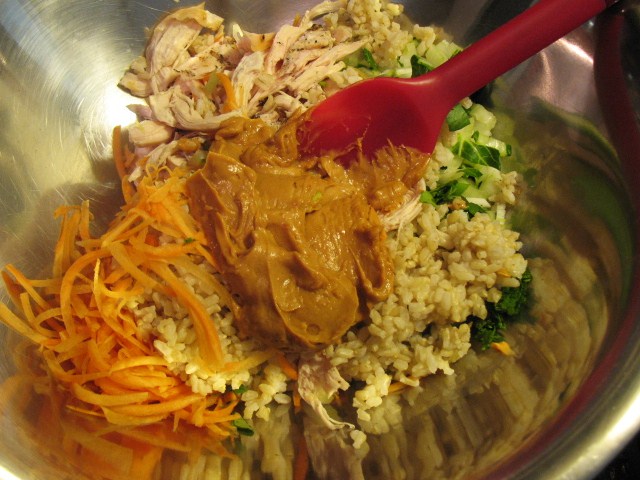
Recently, while I was filing some papers, I came across a rice salad recipe with a spicy peanut dressing. I think I had set it aside with the intention of making it to use up some bok choy, which has been really nice from the CSA this year. I only had to change dinner plans a little bit to make this right away, and I’m quite happy that I made that delicious detour. I only used one large stalk from the huge bok choy head, however, so I’m going to have to find something else to do with the rest of it.

The dressing for this salad is similar to other peanut dressings and sauces I’ve tried, but that just makes it more popular around here. I was originally skeptical about the texture of a thick peanut butter dressing on brown rice, thinking it would just be sticky and mushy, but the chicken-and-vegetable to rice ratio is high enough to keep things from getting too stodgy. The dressing is also a bit simpler than others I’ve made. It consists of just peanut butter and liquid ingredients, so there’s no mincing garlic or grating ginger to hold you back. I warmed the peanut butter in the microwave briefly to make it easier to mix with the other ingredients.


This salad is particularly easy if you happen to have leftover rice and chicken on hand. I used grilled chicken breast, but you could use any cooked chicken. The original recipe called for grilled tofu, so you could use that, or even shredded cooked pork. To save time, you could also use packaged grated carrots or a coleslaw mix in place of the bok choy and carrots. Really, as long as you keep a good balance of rice, protein, vegetables and dressing, you could put anything you like in a salad like this. Gee, if that’s the case, why don’t we make more rice salads?


Chicken and Rice Salad with Spicy Peanut Dressing
Based on a recipe in Cooking Light magazine

1 ½ cups cooked brown rice
4 ounces (about 1 cup) shredded or chopped cooked chicken
1 cup shredded carrot
1 cup thinly sliced bok choy stems and leaves
½ cup finely chopped green onions
¼ cup chopped cilantro
¼ cup creamy peanut butter
1 tablespoons rice vinegar
2 tablespoons soy sauce (I used reduced sodium)
1 teaspoon chili garlic sauce
1/3 cup chopped peanuts

1. Combine the rice, chicken, carrot, bok choy, green onions and cilantro in a large bowl.

2. Place the peanut butter in a small microwave-safe bowl. Microwave on HIGH for 20 seconds. (This will make the peanut butter easier to stir.)

3. Add the rice vinegar, soy sauce and chili garlic sauce to the peanut butter. Whisk until very smooth and shiny. Add the dressing to the rice mixture and stir to coat completely. Top with chopped peanuts.

Wednesday, April 7, 2010

Have Apron Will Travel: Tetrazzini with Mom

Several years ago, I began packing an apron in my suitcase when I traveled to visit friends and relatives. I’ve become so accustomed to my shield against vigorous slopping that I can’t leave home without it. This Easter holiday, during which I visited my family in Upper Michigan, was no exception.


There really weren’t very many opportunities for me to contribute in Mom’s kitchen, since we spent much of our time on mini-trips visiting relatives (including my 89-year-old grandmother who sent us home with some of her freshly-bake cinnamon rolls, which are THE BEST IN THE WORLD!). Mom also has a good handle on things (ie, she’s a great cook) and usually doesn’t need my meddling. Or perhaps she has enough help without me.


One day, though, she pulled out a recipe clipped from a magazine and said, “I thought we could make this.” And on Saturday, we did. It was a makeover of tetrazzini that included vegetables: bell peppers, artichoke hearts and spinach. The accompanying photo alone suggested it would be a winner. I figured I could help with some of the prep work and take photos of all the steps along the way.

Well, this whole thing came together in a sort of charmingly unorganized manner. Some of the steps were out of order, we started with too small of a pan, we replaced this and that, and I didn’t get many good photos after all. It turned out really fabulously, however, and even Dad, who cried, “Why are you putting that grass in there?” as he witnessed us adding the spinach, ate at least his fair share.

This recipe has a lot of steps, but they are all pretty simple. The trickiest part is whisking the broth and flour together to make a thickened sauce. This kind of technique is what was replaced by the dubious condensed cream-of-something soup that seems to have defined family casseroles for quite some time. The addition of the cream cheese to the sauce makes it creamy and tangy and that tang is further enhanced by the artichokes, which bring a bright and special flair to an otherwise stodgy casserole.

I guess I was feeling a bit lazy since I was on vacation, but I didn’t write down this recipe or even take notes on it. The following recipe is from memory, which is now a few days old, so I hope I didn’t miss any important details. I tried to edit it to make more sense than what we actually did in some cases, so there are a few steps that I haven’t actually performed as written, but think they will be better that way.

The traveling apron didn’t get particularly messy, but it did its job. It contributed to the creation of a yummy dish that, along with some dinner rolls (also from Grandma) and a green salad, fed us all very well (and left Mom and Dad some leftovers). My work there was done, and I’ve moved on to other adventures (thank ya, ma’am). Okay, so I’m just back at home, but if you’ve been reading over the last (nearly whole!) year, you know that I can get into plenty of trouble right here, too.

Chicken and Vegetable Tetrazzini
We used chicken broth that had standard sodium content, so if you use a reduced-sodium variety, you might want to taste the dish for salt before giving it a final stir and putting it in the oven.

You could also use cooked turkey in place of the chicken.

2 tablespoons vegetable oil or olive oil, divided
1 ½ pounds boneless, skinless chicken breast
½ teaspoon seasoned salt (such as Lawry’s brand)
8 ounces angel hair pasta, broken into thirds (or smaller)
1 small onion, finely chopped
1 medium red bell pepper, chopped
8 ounces white button mushrooms, cleaned and sliced
1/3 cup all-purpose flour
3 cups chicken broth
4 ounces cream cheese
½ cup grated parmesan cheese
1 can (about 14 ounces) artichoke hearts, drained and coarsely chopped
6 cups baby spinach, any tough stems removed

1. Heat 1 tablespoon oil in a large kettle or Dutch oven over medium heat. Sprinkle both sides of the chicken with seasoned salt and place in the pan. Cook 10-15 minutes or until chicken is completely cooked through, turning about half way through the cooking time. Remove the chicken from the pan and set aside. When cool enough to handle, cut the cooked chicken into bite-size pieces.

2. Cook the angel hair pasta according to package directions until it is just tender. It should still have some bite to it, because it will continue to cook in the casserole. Drain and set aside.

3. Heat the remaining 1 tablespoon oil over medium heat in the same pan in which the chicken was cooked. Add the onion and red bell pepper. Saute about 8 minutes, or until the onion and pepper are tender and beginning to brown. Add the mushrooms and sauté until tender, about 5 minutes.

4. Push the contents of the pan to the side, leaving a space in the center. Place the flour in that space. Slowly add the chicken broth, whisking or stirring vigorously to incorporate the flour without forming lumps. Stir and bring to a boil. Reduce heat and simmer 10 minutes, stirring frequently. The mixture will be fairly thick.

5. Preheat the oven to 350 F.

6. Add the cream cheese to the broth mixture. Increase the heat to medium and stir until the cheese has melted into the mixture. Stir in the parmesan cheese, cooked chicken, artichoke hearts, and spinach. Cover and cook until the spinach has wilted down, about 5 minutes, stirring occasionally.

7. Remove from the heat and stir in the cooked pasta.

8. Oil or spray with cooking spray a 13 x 9-inch baking dish. Spoon or pour the pasta mixture into the pan. Bake at 350 F for 25-30 minutes or until the top is beginning to brown.


Makes about 8 servings.


Note: The photo of Smokey the cat was taken by Harry

Tuesday, December 22, 2009

A Christmas Story and Chinese Food


I’m a big fan of the idea of a dinner with a movie theme. Somehow, I rarely get something like that together, but now that it’s Christmas vacation, the time and the opportunity presented themselves. This is a laid-back dinner for a laid-back Christmas movie, one of my favorites. I wanted a fairly quick and easy meal, and I wanted to watch A Christmas Story. Even though the Bumpus’ dogs hadn’t stolen my turkey, and I wouldn’t be having a Peking duck smiling at me while Chinese waiters sang “Fa Ra Ra Ra Ra,” it still seemed appropriate to serve a spicy chicken stir fry while watching Ralphie pine for a Red Ryder B B gun (with a compass in the stock and this thing which tells time).

The secret to stir fry is much like the secret to a serene holiday season: prepare as much ahead of time as possible. Do I succeed in this? With stir fries, usually. I cook the rice, marinate the chicken, prepare the sauce, and chop everything else before even thinking about heating the wok. My holiday preparations are a completely different story. (Exhibit A: fewer than usual posts this month.) Oh well, as I always say, next year will be different.

Of course when I made this, I let the hot peppers, ginger and garlic go a little too long all alone, and the resulting acrid fumes made us cough all through dinner. I also made this soupier than I would have liked, so perhaps it should have less chicken broth or more corn starch in the sauce. It tasted good like this, and I served it in bowls to contain the sauciness better. It was hot and spicy and holding the bowl close on a cold night while watching A Christmas Story was nice and cozy and just right somehow.

So light your leg lamp and fire up your wok (or a large frying pan) and cook up a spicy chicken stir fry for a pre-Christmas celebration. Just don’t stick your tongue to any flag poles for old time’s sake. And if you do, please don’t bother the fire department. A simple glass of warm water poured over the offending area will solve the problem. Am I speaking from experience? I’ll never admit it. Oh, yeah, and don’t shoot your eye out.

Spicy Chicken Stir Fry Recipe
This is based on Sichuan or Kung Pao chicken dishes in Chinese restaurants. If you cannot find whole water chestnuts, sliced ones will be fine. Serve with hot cooked rice and a pot of tea.

½ cup fat-free, less-sodium chicken broth
2 tablespoons honey
¼ cup soy sauce
¼ cup Shaoxing wine (or sake)
2 tablespoons Chinese black vinegar (or rice vinegar)
2 teaspoons cornstarch
2 teaspoons dark sesame oil
1 pound boneless skinless chicken breast, cut into bite-size pieces
1 bunch (about 8 medium) green onions
1 large (or 2 small) red bell pepper
1 (8-ounce) can whole water chestnuts
3 tablespoons canola oil or peanut oil, divided
1 ½ tablespoon minced peeled fresh ginger
1 ½ tablespoon minced garlic (about 5-7 cloves)
4-6 dried chile peppers
½ cup cashews

1. Combine the chicken broth, honey, soy sauce, Shaoxing wine, Chinese black vinegar, cornstarch and sesame oil in a small bowl. Whisk well to combine.

2. Place the chicken in a medium bowl. Remove ¼ cup of the broth mixture and pour it onto the chicken. Stir well to coat the chicken. Set aside to marinate for 20-30 minutes. (If the chicken will be standing longer than that, refrigerate it until ready to use.)

3. Cut off the roots of the green onions and thinly slice the white and light green part. Set aside. Cut the dark green tops into 1-inch lengths. Set aside separately. Cut the bell pepper into approximately 1-inch squares. Halve the water chestnuts (quarter the larger ones).

4. Heat 2 tablespoons oil in a wok or large skillet over high heat until it appears to shimmer. Add the ginger, garlic and dried chiles. Stir fry (ie, cook while stirring constantly) 30 seconds. These ingredients can produce acrid fumes when heated like this, so avoid inhaling those fumes if possible.
5. Remove the chicken from the marinade with a slotted spoon, and place in the wok. Discard the marinade. Stir fry the chicken 4-5 minutes or until cooked through. Remove the chicken from the pan and place in a clean bowl.
6. Add the bell peppers and white and light green parts of the onions. Stir fry 2 minutes. Add the water chestnuts and stir fry another minute.

7. Return the chicken to the pan and add the sauce. Bring to a boil and cook until the sauce has thickened slightly. Turn off the heat and stir in the green onion tops and cashews. Serve with hot cooked rice.

Makes 4 servings.